
When Food Becomes Medicine
By : Prof. Dr. Kaid Johar SR
Department of Zoology, Biomedical Technology and Human Genetics, Gujarat University, Ahmedabad, Gujarat, INDIA
www.daylifenews.in
We eat every day, but we rarely stop to consider what happens to food once it’s inside us. Beyond satisfying hunger and providing energy, food has thousands of active substances that interact with our cells, influence metabolism, and help maintain good health.
The link between food and health is more fascinating than it might appear. Each meal gives us carbohydrates, proteins, fats, vitamins, minerals, and many plant compounds. Some of these can influence the chemical processes that control cell growth, inflammation, antioxidant protection, and the removal of damaged cell parts.
Plants provide more than nutrition
Fruits, vegetables, beans, seeds, and spices contain many compounds known as phytochemicals. Polyphenols, flavonoids, carotenoids, and other plant molecules have attracted significant scientific attention for their potential effects on our bodies.
For example, blueberries contain anthocyanins, the pigments that give them their colour. Soybeans have isoflavones like genistein. Broccoli and similar vegetables contain glucosinolates, which can become compounds such as sulforaphane. These substances act in different ways, but lab studies suggest some may influence cell communication, stress responses, and the activity of genes that help keep cells healthy.
One interesting process includes the body’s own antioxidant defence system. Certain compounds in food can activate cell mechanisms that increase the production of protective enzymes. Instead of only neutralising free radicals, these food molecules may change how cells manage oxidative stress.
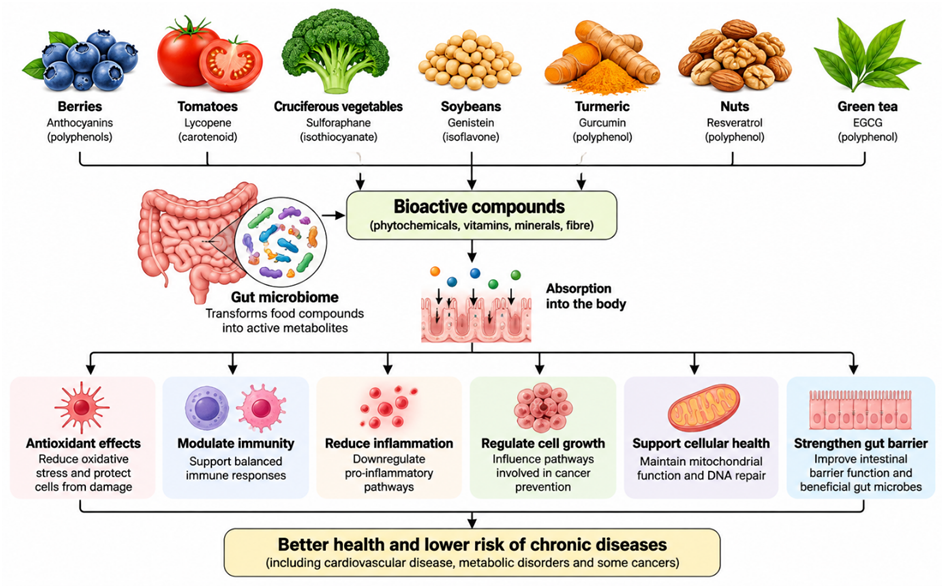
However, remember that a compound showing strong effects in a lab dish might not work the same way after we eat it. Digestion, absorption, how the body handles it, the amount we consume, and interactions with other foods all influence its effects in the body.
Our gut: A meeting place for food and microbes
Food doesn’t just interact with our own cells. It also feeds the huge community of microorganisms in our intestines, known as the gut microbiome.
Dietary fibre is especially important because many helpful gut microbes use it as their food. When they break fibre down, these microbes produce substances called short-chain fatty acids, such as acetate, propionate, and butyrate. These products can influence the gut lining, immune system, and metabolism.
The relationship works both ways. Gut microbes can also change some plant compounds into forms that are easier for us to absorb or that act differently in the body than the original substances. The health effects of a certain food may partly depend on the microbes living in a person’s gut. Two people eating the same food might not process all its parts in exactly the same way.
Can food influence cancer development?
Cancer develops through a complex mix of genetic changes, altered cell signalling, surrounding factors, and interactions with nearby tissue. Some cancer cells can grow uncontrollably, evade the immune system, and spread to new areas. Research has shown that some compounds in food can affect processes linked to cell growth, programmed cell death, inflammation and cell stress. These outcomes have led scientists to explore whether molecules from food might help prevent cancer or be used to. But it’s important to note that affecting a cancer-related process in lab-grown cells is different from actually preventing cancer in people. Many plant compounds look promising in experiments, but we still don’t know how well they work, what amounts are needed, or how safe they are for real patients.
So, a healthy diet should be seen as one part of a bigger plan to lower disease risk, not as a replacement for cancer screening, medical advice, or proven treatments.
Food and the ageing cell
As we age, our cells change how they use energy, build up molecular damage, and repair themselves less efficiently. Oxidative stress and long-term inflammation can worsen these changes, but neither alone fully explains ageing.
A balanced diet with plenty of vegetables, fruits, beans, whole grains, nuts, and other nutrient-rich foods gives cells what they need to stay healthy. It may also support a robust gut microbiome and lower the risk of many long-term diseases.
The goal isn’t to look for a single miracle ingredient. Instead, it’s about comprehending how our overall eating habits affect the body over many years.
The message behind our meals
Perhaps the most exciting idea is that food is always connecting our environment and our biology. What we eat can influence the nutrients our cells receive, the microbes in our intestines, and the chemical signals that help control normal body functions. Some findings are well established, while others remain promising hypotheses awaiting confirmation in human studies.
The practical advice is simple: eat a varied, balanced diet, include lots of different plant foods, get enough protein plus essential nutrients, and don’t rely too much on single superfoods or unproven supplements.
Every meal is a chance to nourish your body. The real power of food isn’t in a single miracle molecule, but in the complex relationship between what we eat, our cells, our microbes, and our lifestyle.