Prof. Dr. Kaid Johar SR
Department of Zoology, Biomedical Technology and Human Genetics, Gujarat University, Ahmedabad, Gujarat, INDIA
www.daylifenews.in
Artificial intelligence has entered almost every area of science, including biology. This has led to a frightening question: Could an advanced AI design a microorganism capable of killing all humans?The idea resembles science fiction, but the underlying question deserves serious scientific discussion.
AI can already help researchers study huge amounts of biological data, predict protein shapes, find possible drug targets and create biological sequences. As these skills get better, worries have naturally come up about how they might be misused. For example, an AI system might give information that helps someone design or change a microorganism with harmful traits.
But an important distinction exists between providing information and creating a biological catastrophe.AI does not release a microorganism into the environment on its own. A person or an automated lab system must turn a computer design into a living organism and then let it into the environment. Every step involves very complex biological processes.
Biology is not completely predictable
One key point often missing in talks about AI and biological risks is that we do not fully understand microorganisms.
We know a lot about viruses, bacteria and other microorganisms. We can read their genetic codes, study their proteins, and test many of their biological processes. But knowing an organism’s genetic code does not mean we can predict exactly what it will do.A microorganism lives inside a complex biological system. How it acts can depend on its host, surroundings, immune reactions, mutations, interactions with other microorganisms and many other things.
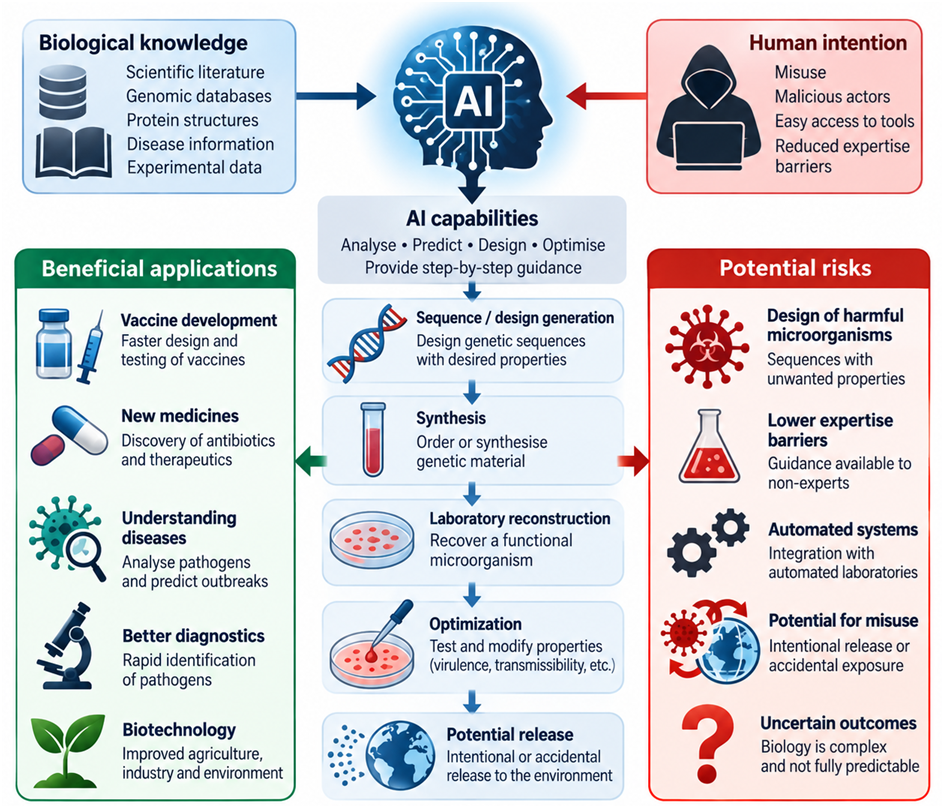
Consequently, designing a particular genetic sequence does not automatically mean that we can predict its behaviour in the real world.
Could a highly dangerous microorganism be designed?
This is where the question becomes more complicated.
A microorganism would need to meet many biological conditions to cause a worldwide disaster. It would have to survive, infect the right hosts, reproduce well, spread between people and keep spreading through groups. If it causes a serious disease, that disease would also need to affect enough people.These properties do not necessarily come together simply because a particular genetic sequence has been designed.Biological compromises can happen between traits like how easily a disease spreads and how harmful it is, though these are not strict biological rules. Some germs can spread easily while also causing serious illness. So, we should not assume that nature stops very dangerous germs from appearing.
At the same time, we should not assume that AI can tell biology to create such an organism and get a predictable outcome.
The more realistic concern
Perhaps the most important concern, then, is not that AI itself will kill humanity.
The greater concern is that AI could become a strong tool in the hands of someone who wants to misuse biological science.But this possibility is not unique to AI. A knowledgeable scientist, a textbook, a research paper, or an experienced mentor can also provide information that could be misused.What AI changes is how fast, easy, and widely help is available. Someone with less biology knowledge may more often get detailed explanations, study large amounts of research, and get help with difficult biological problems.
That is a genuine biosecurity concern.
From “AI will kill us” and “Can AI kill all humans?”
A better question is:
“How much can AI lower the barriers to performing biological activities that were formerly limited to highly trained specialists?”
That question is much more useful because it can be investigated scientifically.
If AI becomes more linked with automated biology labs, the situation could change more. An AI system could help design an experiment, study the results and suggest the next experiment. These mixes of AI, biological databases, creation technologies and lab automation need careful watching.
At the same time, these technologies could help people find new medicines, create vaccines, understand diseases, and react faster to new infections.
The real lesson
Microorganisms have evolved and interacted with humans for millions of years. We understand some of their biology remarkably well, while other aspects remain poorly understood.
AI does not change that fundamental biological complexity.It changes how fast people can search, study and use the knowledge we already have.Therefore, the smartest response is neither to ignore the worry nor to think an AI-made super-pathogen is certain. Instead, we should improve biological safety, responsible AI development, lab supervision, and systems that stop dangerous biological information or abilities from being misused. Anger is not simply AI versus humanity.
It is the combination of human intention, powerful technology and incomplete biological knowledge.
And that is a much more interesting—and much more scientifically realistic—question.